Last May, I took a mad notion to buy a ticket to a rock concert by one of my favourite Swedish musicians, Lars Winnerbäck, who was going on a winter tour in Sweden. After much checking of flights and accommodation, it seemed the best option would be to buy a ticket to the concert scheduled for Malmö on 3rd November, during my Halloween break from work. I could fly to Copenhagen, get the train to Malmö and stay with a good friend of my husband there, only 10 minutes’ drive from the Arena. I bought the concert ticket!
Needless to say I started to doubt the wisdom of my plans when autumn came and the days got darker and the weather colder, and that was just in Ireland. I hadn’t actually paid for the flights and for the hostel room yet and I considered putting the concert ticket up for sale.
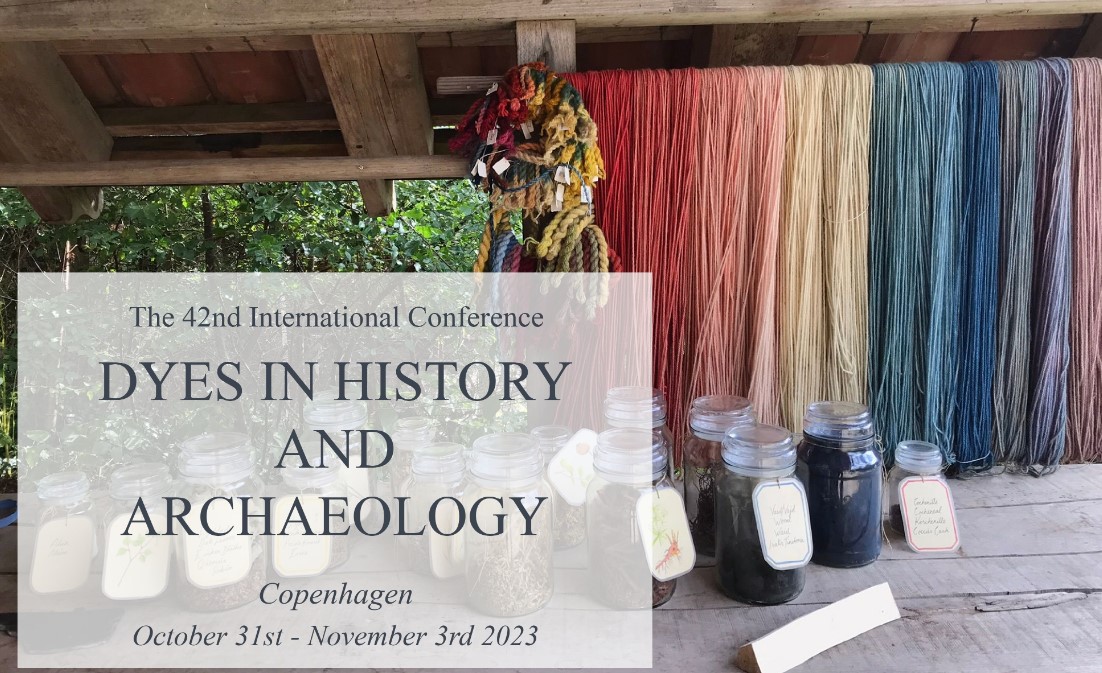
Then I decided to check out if there was anything interesting (read: textile-related) on in Copenhagen University at the Centre for Textile Research to help justify the trip and wow, amazingly, there was: a 4 day conference called Dyes in History and Archaeology, starting on Tuesday 31st October and finishing with optional museum tours on Friday afternoon, just in time for me to get back to Malmö for the concert that evening. Perfect, and all the more so for me, as I could combine some of my favourite things: travel, Scandinavia, music and textiles.
Even more amazing was that the Conference was reasonably priced (€65 pp in person, free to participate online) and open to laypeople/crafters like me. I had another busy evening of checking and double checking flights, rooms and costs and then, I just went for it. I booked and paid for my flight to Copenhagen Kastrup from Dublin on Monday 30th October, a single room for a few nights in the Danhostel near Tivoli and my flight home from Kastrup to Dublin on Sunday 5th November. Almost a whole week away. Gulp!
Monday the 30th October came and my patient husband dropped me to the airport coach in Limerick and off I went on my way to Dublin Airport. Meeting two old friends from Sweden unexpectedly in the departures lounge in Dublin felt like a very good omen indeed, especially when Martin said he would himself be in Copenhagen the following day.
Arriving into Kastrup and Copenhagen itself was wonderful. There were so many bicycles and so many different types of bike, from wagons with seats for children to carts carrying all kinds of stuff.
The first day of the Conference was a very wet day and I had to take a taxi to the venue. While I was waiting outside the hostel for the taxi, I was astounded once again at the steady stream of determined cyclists passing by each time the traffic lights down the street changed.
Day 1, Tuesday: One of the highlights for me was listening to Dominique Cardon speaking about the mysteries of a 18th century French manuscript about wool dyeing that she is currently working on, and then chatting briefly to Dominique in the queue for the coffee and croissants at the break.
There were several other interesting presentations, some about manuscripts and recipes for dyeing, some about natural dyes used in tapestries, one about the tradition of dyeing eggs in Ukraine and one about dyeing fish leather with native Arctic plants. There was a display of samples of the dyed fish leather and this was very impressive. I have since learned that strips of fish skin leather and eel skin leather were used to wrap around flax fibre on the distaff to keep it in place for spinning.
The conference was taking place in an area of Copenhagen called Holmen which had previously been the Naval base for over 300 years. The converted naval building that we were in was a single storey old brick building with high ceilings, tall windows and large rooms, part of the Royal Danish Academy for Architecture, Design and Conservation. There was an exhibition called “Planetary Boundaries – Rethinking Architecture and Design” in the next room to us, which we could look at during the breaks. I took some photos of interesting projects here.
After the talks, we walked to the Institute of Conservation which is housed in what were once residential houses on Esplanade 34. We had a wine reception and then we were given a tour of the Institute. We climbed up and down many sets of stairs and went across the courtyard, and saw the labs, and the various sections where students learned how to conserve many different types of materials, including textiles, printed paper, paintings, frescoes, etc.
Day 2, Wednesday: Today was a much brighter day and the venue was within walking distance so I walked to the new Copenhagen University, all the while watching out for bikes at junctions (so many, all going so fast…)
Blue was the theme for the start of the day, with presentations on the use of natural indigo in Japanese textiles, the invention of synthetic indigo and the use of blue colorants in Amazonian masks. Later, there were talks on the identification of dyes used to colour a waistcoat from UK and analysis of the dyes on tapestries from Romania, a silk wall hanging from Denmark and fabric from Turkey.
After the talks, then Poster Session was open. There was a poster by a Norwegian woman, Kari Helene Kullerud, who had dyed several different samples of fabrics with logwood taken from a piece of logwood which had lain at the bottom of the sea in a shipwreck for over 200 years. She compared the colours obtained with those obtained from modern logwood. Amazingly the submerged logwood gave quite good colour.
There was a poster by Alexandra Lester-Makin called “Colours of textiles and braids in an early medieval hoard buried in Galloway, Scotland in c 900CE”. Alexandra was very interesting to talk to about the findings. I see just this week (Jan 2024) that her book about the findings is soon going to be published: “Textiles of the Viking North Atlantic: Analysis, Interpretation, Re-creation” by Alexandra Lester-Makin and Gale R. Owen-Crocker.
Other interesting posters dealt with dyes on textiles found in Iron Age burials in Finland and the dyes used in Finnish folk costumes.
That evening we had our conference dinner which was an optional extra. The venue was a cellar restaurant in part of the old University buildings. It was very convivial and very atmospheric!
Day 3, Thursday: Another bright day and off again to the new University buildings with me. Today was a day about Red dyes and about early dyes, including Early Mycenaean textiles; also about dyes from the Eastern Baltics and new dye analysis of the textiles found in Haithabu/Hedeby, a settlement dated to the Viking era.
Following the talks and a last look at the posters again, there was a reception at the Centre for Textile Research itself. Now here there were fabulous things to see and touch and take photos of: they had their warp-weighted loom set up in one office and linen samples nearby, plus the typical tools that a woman would use for spinning and working with wool, linen or hemp in the Viking era. There were baskets of warp weights, lengths of handspun handwoven linen, Viking era wool combs, spindles and whorls, small scissors, a reconstruction of a Niddy Noddy from the Oseberg ship burial, balls of plant-dyed wool, lengths of handwoven cloth of linen and of wool, samples of tablet weaving in progress and several books and posters all around. What an incredibly interesting place to work or study!!
Day 4, Friday: there was an optional tour of the National Museum which was a very good idea, as the tour guide took us specifically to the textile-related exhibits. And so it was that we saw the 14th century clothing from Herjolfsnes in Greenland as well as other textile finds from burials from the Bronze Age and later.
Later I wandered around in the museum myself and saw a wonderful collection of clothing from Inuit people and an exhibition about Navajo rug weaving.
After a great conference, I travelled on to Malmö and went to the Lars Winnerbäck concert. It was everything I had hoped it would be!
On Saturday, I retraced my steps to Copenhagen and on to Roskilde, where there is a Viking Ship museum. I am really interested in Viking era archaeology, as you may have figured out by now.
Well, Saturday the 4th of November was a special day at the Viking Ship museum in Roskilde, as it was the day that all the replica Viking ships were going to be taken up out of the water for the winter season.
I arrived in time to see the largest ship of all be pulled carefully up out of the water by a team of volunteers and a helpful modern truck with a winch, too. The ship was Havshingsten fra Glendalough (translates to The Sea Stallion from Glendalough). The original of this ship was built in Dublin with timbers from Glendalough in Wicklow in the year 1042. The reconstructed ship was sailed from Roskilde to Dublin in the summer of 2007 and then put on display in Dublin. It was sailed back to Roskilde in the summer of 2008. Many of you may have been to see the ship in Dublin, not I sadly, and so it was with great pleasure I watched as the team ably pulled and guided the ship out of the water on that fresh November day in Roskilde.
All that was left of my trip was to have a good potter around in the Museum itself and see the remains of the actual Viking ships on display there and have a look at the workshops where they build and maintain the replica ships.
In summary, I had a fabulous time at the DHA Conference and I found it really enjoyable. I chatted to people from all over the world and participated in every aspect of the conference. I did lots of spinning quietly on my lap with my little mini Turkish spindle and my own design of a K’nex spindle. After all, there is no point in going to a textile event if you don’t do some spinning!
The really good news is that this conference takes place annually. Next year’s conference is going to be on in Leeds in UK. I urge everyone to keep an eye out for information about the upcoming conference and to consider going and having a great time. If you cannot get away to the conference, remember that free online participation may well be available (it was this year).
More details here: https://www.dyesinhistoryandarchaeology.com/next-meeting.php
 The Irish Guild of Weavers, Spinners and Dyers