The Association of Guilds of Weavers, Spinners and Dyers in UK holds a Summer School every 2 years. Summer School consists of a week long course in a chosen topic, usually spinning, weaving or dyeing, but there can also be other related crafts included. One has to apply for a place before the 31st of December the previous year. You choose 3 courses in order of preference and hope that you get your first choice.
I decided late last year that I would try to go to Summer School in 2023 (SS2023). Carpe Diem, and all that! However, due to illness, I didn’t apply in time. I applied in early January and I was put on the Reserve list for any of the 4 spinning courses on offer. I was delighted to be offered a place on a Spindle course, called A Spindle A Day, given by Amanda Hannaford. Some Guild members will recall that Amanda came to Ireland some years ago and gave us courses in spinning Flax, spinning Silk and in how to spin Woollen and Worsted.
I paid my deposit to AGWSD and booked my ferry ticket in collaboration with Máire (IGWSD Guild Secretary). SS2023 would start on 13th August and end on 20th August. The venue was Harper Adams University in the Telford area, Shropshire, about 3 hours’ drive from Holyhead.
Sunday the 13th August dawned bright and sunny, and the ferry trip over from Dublin Port to Holyhead was calm and relaxing. Máire, Gethin and I sat in the Club Class Lounge and laughed and chatted the whole way. The drive to Harper Adams was easy with some wonderful views of the North Wales coastline.
Harper Adams is a renowned agricultural university, as witnessed by the large (4metres tall) pair of orange wellies in the grounds, and the presence of the farm units next to the registration building. The smell of pigs was evident once we stopped the car, but not once did that interfere with the SS. We registered, got a gorgeous unique ceramic mug each and a lanyard plus room key and the adventure began!
We had a wonderful week at Harper Adams, in all aspects. First the course:
In our course, Amanda provided us with a daily goody bag of spindles (handmade by Amanda’s wonderful husband Ginge) and fibre and we worked our way through them for the week.
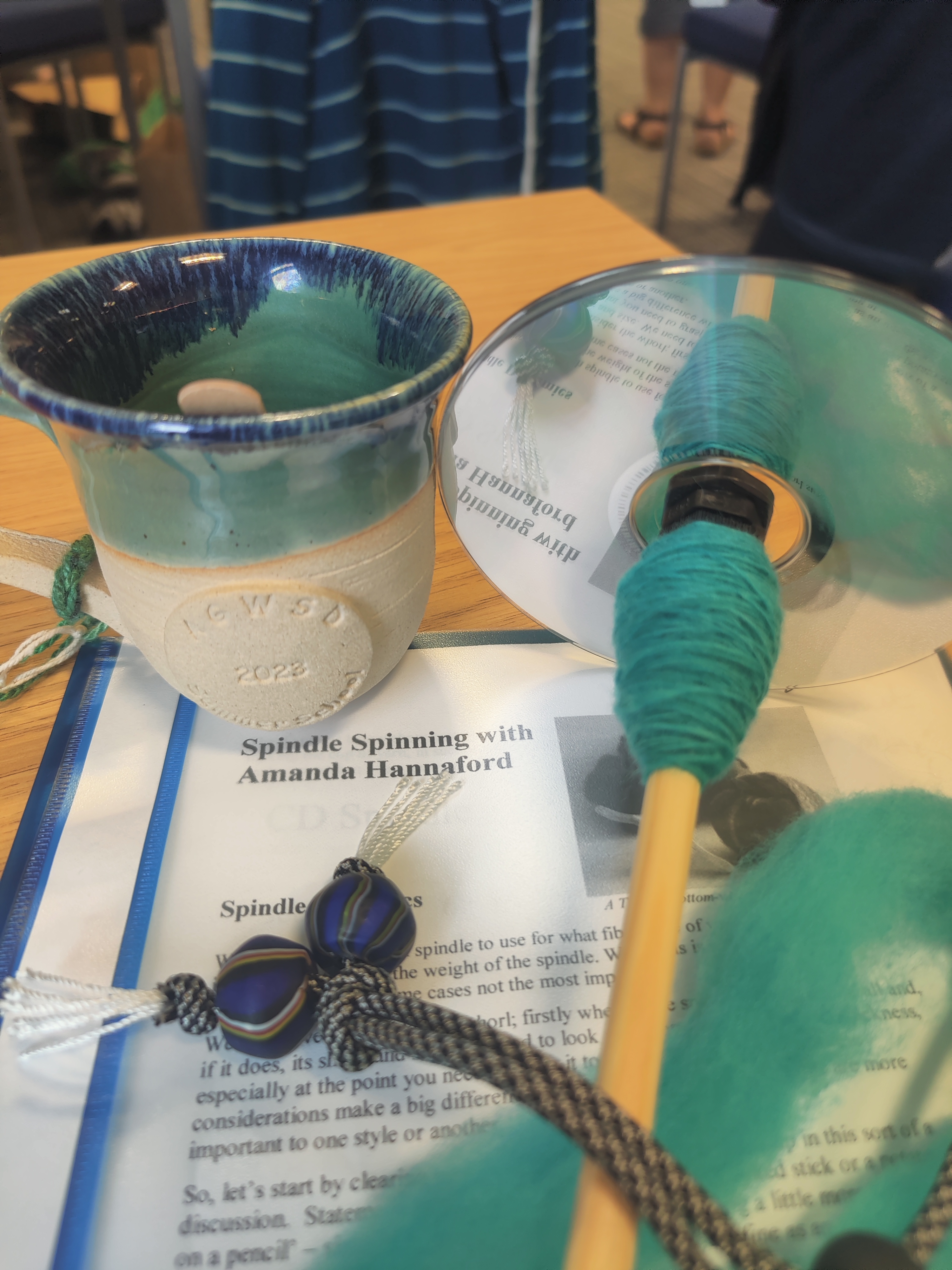
Day 1 was Suspended spinning on homemade CD spindles, with a gorgeous wristaff to help hold the fibre in place on our wrists. We also learned to spin English Long Draw on the CD spindles. We learned how to do Bracelet Plying, to ply off small amounts of yarn. This was a very useful skill for the week, as it turned out.

Day 2 we were introduced to the world of Supported Spindles. We each got a Tibetan style wooden supported spindle and a small spindle with a bead for a whorl. We made punis from cotton lint and a small dowel. Then we spun the cotton on the bead spindles. We also tried out various types of bowls and shallow dishes to use with the supported spindles, some custom made, and some ‘found’.

Day 3 was a half day of class with an optional outing in the afternoon. In class, we spun wool on a grasped spindle (handheld, not suspended) with a lovely bump of wool tied to a medieval style stick distaff. I had brought another stick with me, so I tried out spinning some flax from my stick distaff on the grasped spindle too.
There was a choice of outings, which most of us had pre-booked in June. People could opt to have a quiet afternoon on campus instead, or go on their own outing, or head to Colormart warehouse which had opened its doors exclusively for SS attendees.
I chose to go on an outing to Ironbridge Coalbrookdale and Darby Houses and see the Costume Project workshop, which was fascinating. Others went to the Tile Museum, to an Alpaca farm, etc.
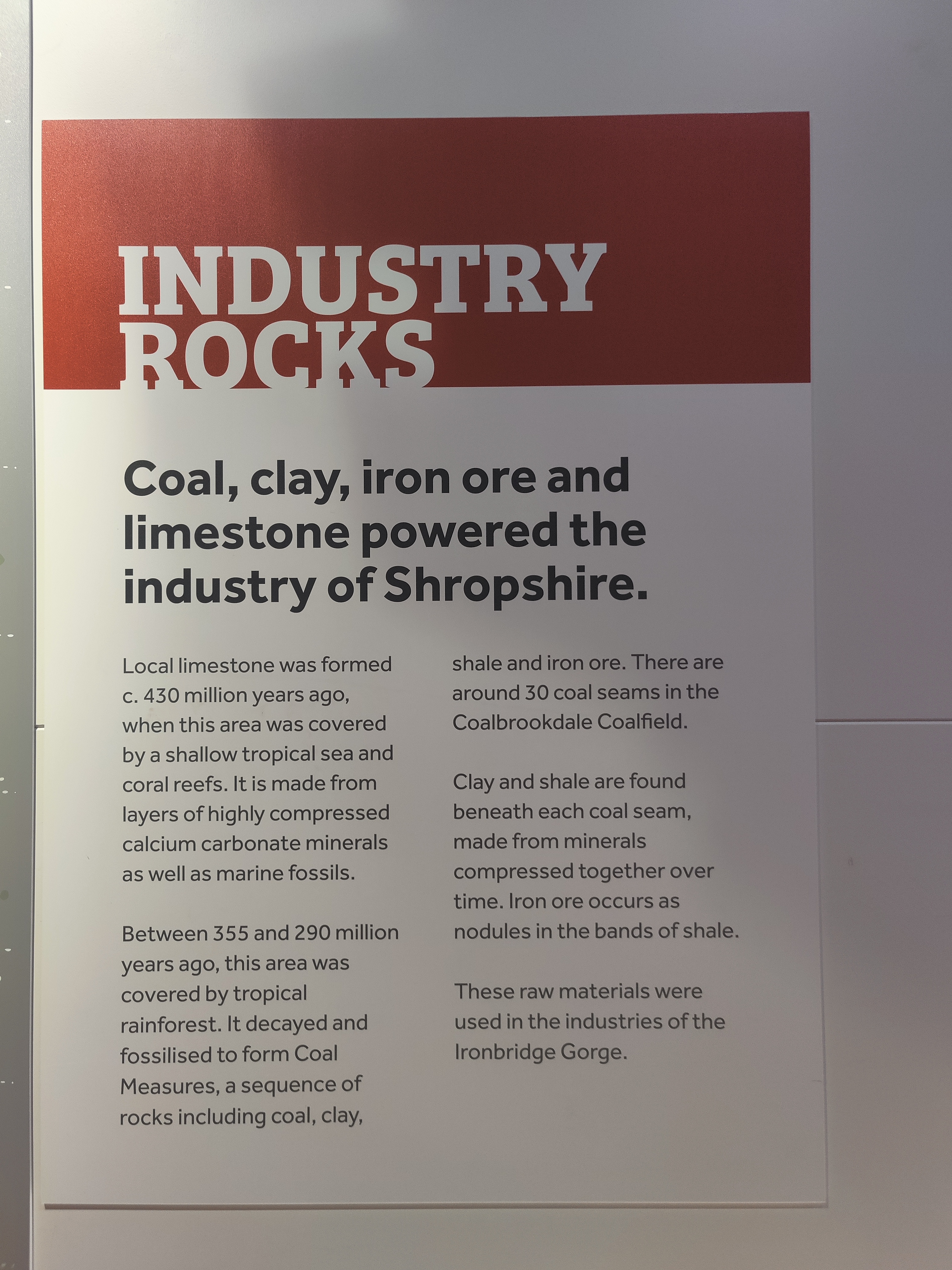
The drive down the Severn Gorge was an experience in itself. I believe it is the home of the Industrial Revolution. “Ironbridge is set within the heart of a UNESCO World Heritage Site. Stretching along the River Severn, these award-winning museums are within 6 square miles of the Ironbridge Gorge, widely regarded as the birthplace of the Industrial Revolution.”
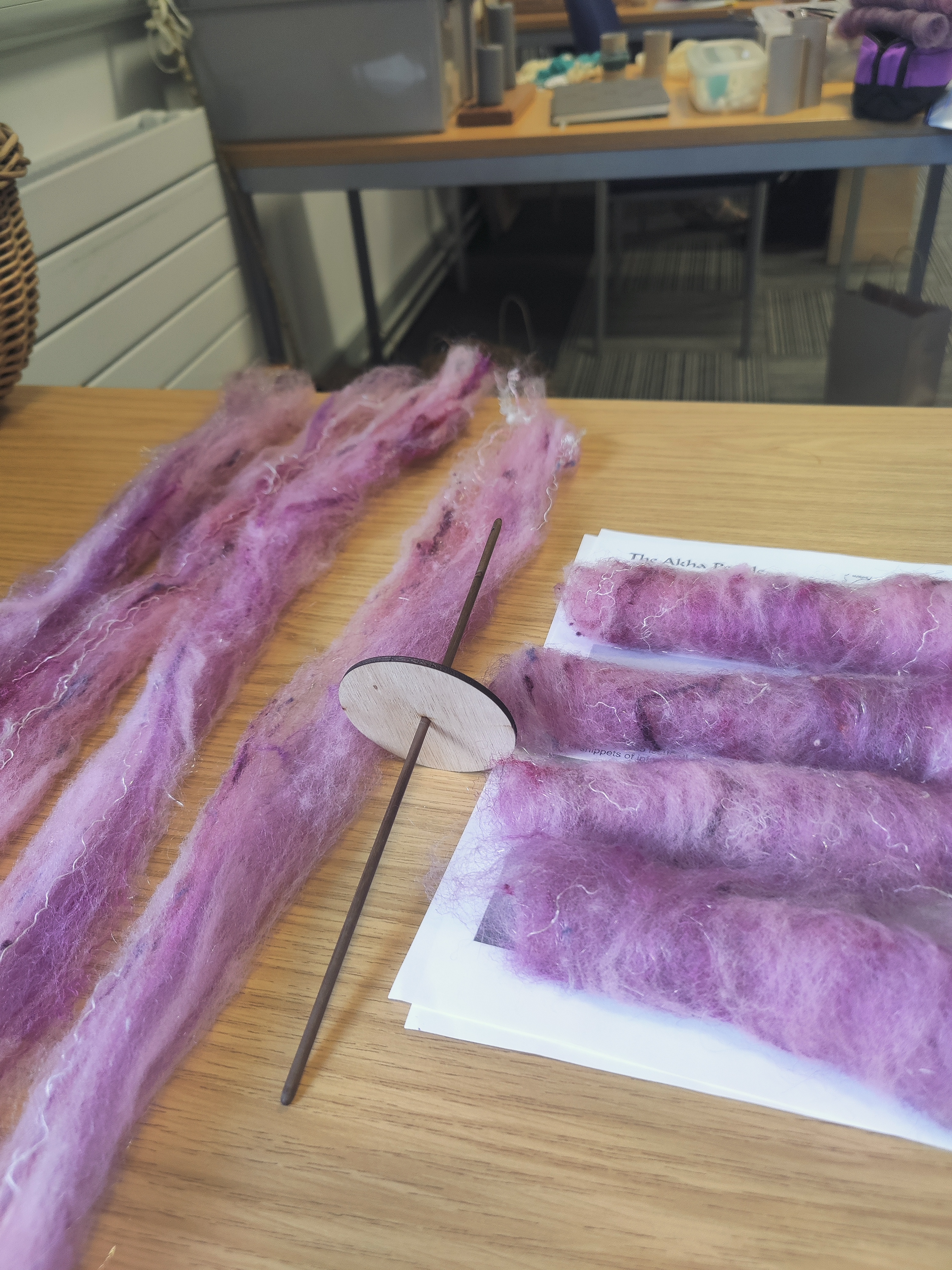
Day 4, Thursday, was the day of the Akha spindle. The Akha spindle looks like it shouldn’t even work: it has a skinny shaft, a skinny disc for a whorl, which is neither top whorl nor bottom whorl, but middle whorl. One uses it by holding it horizontally and twisting it in one’s hand. Amazingly, the Akha worked very well for spinning cotton and I think we all fell in love with our Akha spindles that day.


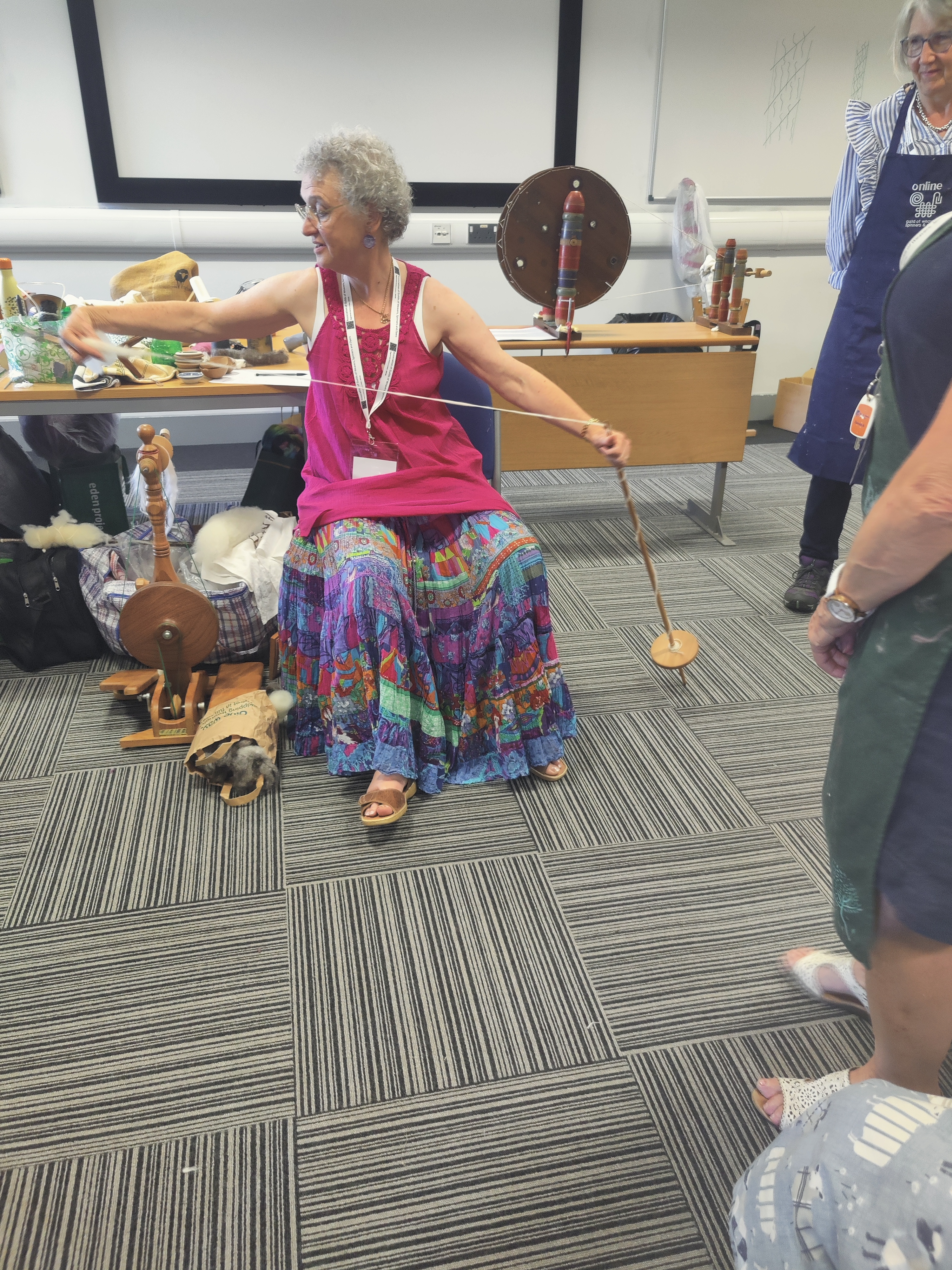
Day 5 was the day for Driven spindles, so that meant spindle wheels. Amanda had brought a Great wheel also known as a walking wheel, as well as a Pakistani hand cranked spindle wheel, a selection of Indian style Charkhas and the pièces de résistance (yes plural, because there were two): two amazing US-style spindle wheels built by Peter Teal UK, author of the book Hand Wool-combing and Spinning. Amanda and Ginge now own Peter’s magnificently graceful pendulum wheel and his fascinating trolley wheel.

Pendulum wheels and trolley wheels were built in the US in order to improve efficiency and production rates in spinning, especially cotton spinning, at a time when the Industrial revolution had not yet reached the US. These types of wheels arose out of the tradition of the Great wheel which the settlers from UK had brought over to USA. In UK the Great wheel was replaced by the industrialisation of spinning, but in US Great wheels persisted for longer out of necessity. Pendulum wheels and trolley wheels were designed to help speed up the process of spinning before industrialisation arrived there.

Peter Teal had seen these wheels in the US and built his own versions of them back in the UK.

I was completely bowled over by being in the presence of these two wheels, which I had only ever seen on photos on the internet heretofore. I was delighted to be able to see them being operated and explained by Amanda, and then to have a go on them myself, spinning cotton.
The pendulum wheel elongates the length of the draw possible on the wheel by having a hinged arm that swings away from the spinner. The spinner controls the swing of the pendulum wheel with a foot pedal.
The Trolley wheel equally extends the length of the draw available to the spinner by having the mother of all set up on a small carriage that rides on a wooden rail/track away from the spinner, once again attached by a complicated set of cords and controlled by a foot pedal.
The Charkhas are also worthy of note. These are ingenious driven spindles in a folding portable wooden box, one of which was used by Gandhi to spin cotton in his fight for independence for India. The styles we had in class ranged from genuine small charkhas bought second-hand in India for less than £20 right up to modern high-end charkhas from Bosworth.
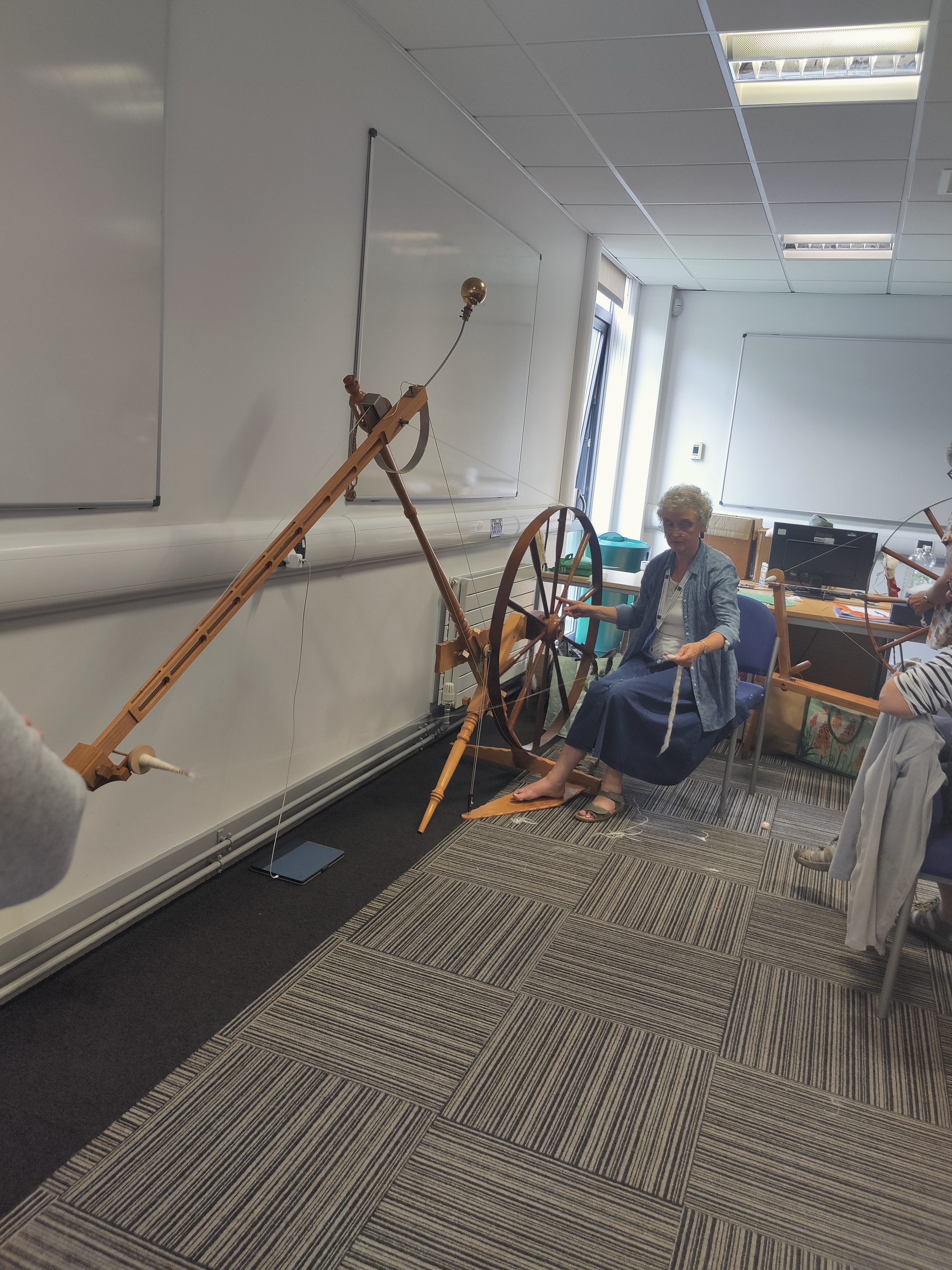
We spent a wonderful day on Friday trying out all these various types of spindle wheels.
On Saturday we had a few short hours in class where Amanda showed us how to use a floor supported Navajo style spindle and we got to ask any remaining questions. Then it was time to set up our room to show our work to the other participants. In the afternoon, we all had a chance to circulate and see the work in the other classrooms, as well as supervise our own class for a time and show people around.
That evening, we had our Gala dinner and the Fashion show. This was a Fashion Show with a difference: the weavers, spinners and dyers modelled their own creations, some of which had been made during the week, and some of which had been made at home over the past 2 years. I must say it was very inspiring to see the finished products, as it really brought it all together to see how an idea can become a cloth and then a garment.
Sunday was our last full breakfast and by then we had packed up and were ready to ship out. So after a lovely last breakfast and some goodbyes, off we headed.
The entire week was an inspiring and educational experience. Not only were we in class every day but there were events every evening and these were just as fascinating as the classes. There was a presentation by the Online Guild, followed by a story telling session and a craft and natter session. There were two talks, one by Teresinha Roberts, about silk and her experiences raising silkworms, and one by Sarah Thursfield, the author of the book The Medieval Tailor’s Assistant, both of which were very interesting. There was were exhibitions of work by the candidates for the Certificates of Achievement in Spinning and Dyeing. There was an exhibition of work by tutors and graduates from colleges of Art and Design. And there was the Fashion Show.
There were a few trips to the pub on campus, which was called The Welly Inn. (The coffee shop was called Graze and the food store was called the Feed Store!)
There was a silent auction with spinning wheels, looms, books, magazines, etc, a bit like eBay but in person. I took photos of several of the beautiful things for sale, in order to show my family all the things I could have bought but didn’t!
There was a trade Fair, where well-known shops such as Michael Williams Woodturner, HillTop Cloud and The Threshing Barn came to show and sell their wares. Yes, dear reader, I bought some things.

Everything about Summer School was great. One aspect that I really enjoyed is the feeling that no matter where I sat or who was beside me, I knew I would have a like-minded person to chat to and I knew I was always going to have enjoyable and interesting conversations with the people I met.
I have to say that the staff and the facilities at Harper Adams were also fabulous. We were fed and watered all day every day. The price of SS includes the tuition, the accommodation (single en-suite student rooms), food : breakfast, lunch and dinner as well as tea /coffee and biscuits twice a day at break times. There was no need to spend another penny on food. We were well catered for.
The team of members of the local guild who organised the Summer School deserve the highest praise for the wonderful event they created for us all.
It was my first Summer School, the first of many!
 The Irish Guild of Weavers, Spinners and Dyers
Was accommodation supplied? And what was the course cost?
Sounds great!!!
Hi Janet! Yes accommodation and food were included in the cost, which was about £785. There were other options too though, such as camping/using your own campervan or caravan on the campus grounds, which cost less. And there was a Non-Resident price if one lived close enough to not need accommodation, so meals were not included, just the Gala Dinner, for about £285. One could bring a companion too who would not be attending a course, and there was a sliding scale of costs for companions, depending on whether the companion required meals, etc or not. I can email you the application brochure from last December if you would like to have a read of it to get an idea of what it was like. And yes, it was great! We had a great time. And I am definitely going again!